Somalia seeks Saudi-Egypt alliance over Red Sea security
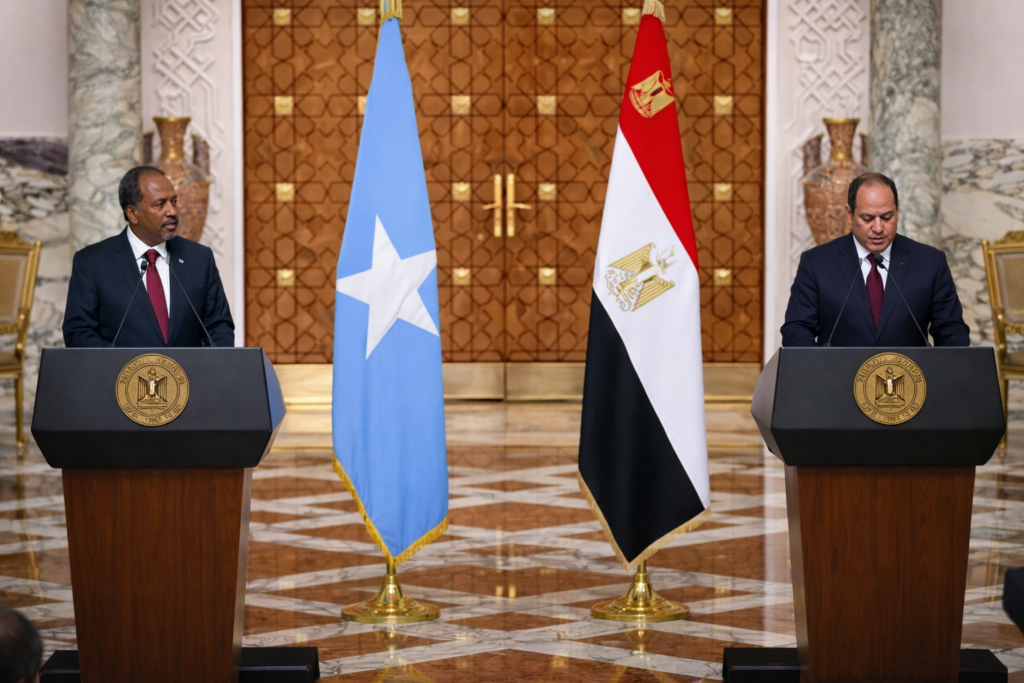
Mogadishu (Somalia Today) — Somalia is pushing for closer security coordination with Saudi Arabia and Egypt across the Red Sea corridor, a strategic counter-move designed to blunt the fallout from Israel’s recognition of the breakaway region of Somaliland.
State Minister for Foreign Affairs Ali Omar said Mogadishu seeks a “durable framework” with Riyadh and Cairo to protect the Red Sea and the Gulf of Aden, aiming to reinforce Somalia’s territorial integrity amid outside powers expanding their footprint in the Horn of Africa.
In an interview with Al Majalla, Omar argued that Israel’s move was not a symbolic political gesture but a decision with strategic implications for the Red Sea basin—a waterway that handles a massive share of global trade and sits at the crossroads of conflict from Yemen to Sudan.
Israel announced the decision on December 26, with Prime Minister Benjamin Netanyahu declaring it marked the official recognition of Somaliland as an “independent and sovereign state.”
Somalia’s government immediately rejected the move as a breach of international law and an assault on its sovereignty, vowing to pursue diplomatic and legal countermeasures.
Omar welcomed what he called the “principled position” of Arab states, particularly Saudi Arabia, in rejecting the recognition.
Red Sea calculus
For Mogadishu, the dispute has widened beyond the status of Somaliland, which declared independence in 1991 but had not secured formal recognition from any UN member state before Israel.
It has become a question of who shapes security in a corridor increasingly crowded with foreign militaries, port operators, and intelligence assets.
With one of Africa’s longest coastlines, Somalia flanks shipping lanes linking the Mediterranean to the Indian Ocean.
Officials in Mogadishu argue that stability along this route depends on internationally recognised borders, warning that recognising Somaliland could trigger new competition over ports, access agreements, and maritime surveillance.
Omar said Somalia wants “structural cooperation” rather than new bloc politics. He described a model rooted in shared responsibility and collective defence against threats such as terrorism, piracy, and “external interference.”
He pointed to Saudi Arabia and Egypt as natural anchors for this coordination, reflecting both countries’ influence in regional diplomacy and their vested interest in Red Sea security.
Turkey, a key security partner for Somalia, condemned Israel’s move the day it was announced, calling it unlawful and destabilising.
Somalia also took the issue to the United Nations; days after the announcement, a Security Council meeting record noted Somalia’s condemnation and broader concerns about regional stability.
While Somaliland welcomed Israel’s move, Mogadishu sees it as a test case that could lead others to treat federal member states as independent, contrary to Somalia’s constitution.
The insurgent threat
Omar’s call for deeper Arab coordination comes as Somalia tries to sustain counterinsurgency operations under tightening financial and political constraints.
He rejected arguments that the persistence of Al-Shabaab and Islamic State-linked fighters proves the government has failed.
Omar insisted the state has expanded its authority since the 1991 collapse and that Mogadishu is markedly safer than in earlier phases of the conflict.
Still, he acknowledged the scale of the challenge. Al-Shabaab remains one of the most capable groups aligned with Al-Qaeda, while Islamic State-linked fighters maintain a foothold in the northeast.
Somalia’s security campaign relies on national forces backed by international training and funding. However, the external environment is shifting.
Omar noted that Washington has reduced assistance globally and said Somalia is adapting, even as it seeks to preserve US engagement in counterterrorism.
In early January, the United States paused assistance programs benefiting the federal government after alleging Somali authorities demolished a World Food Programme warehouse in Mogadishu and seized US-funded food aid. Mogadishu denied the claims.
Washington’s initial announcement cited a zero-tolerance approach to aid diversion, adding that any resumption would depend on the government’s accountability measures.
The episode underscored the fragility of Somalia’s external financing at a moment when the administration faces a high-stakes diplomatic contest over Somaliland.
Omar framed the Saudi-Egypt track as part of a broader effort to harden Somalia’s position on sovereignty while widening the coalition against militant threats.
He said Somalia wants partners who treat the country’s borders as the basis for stability—not as variables in a shifting regional power map.